
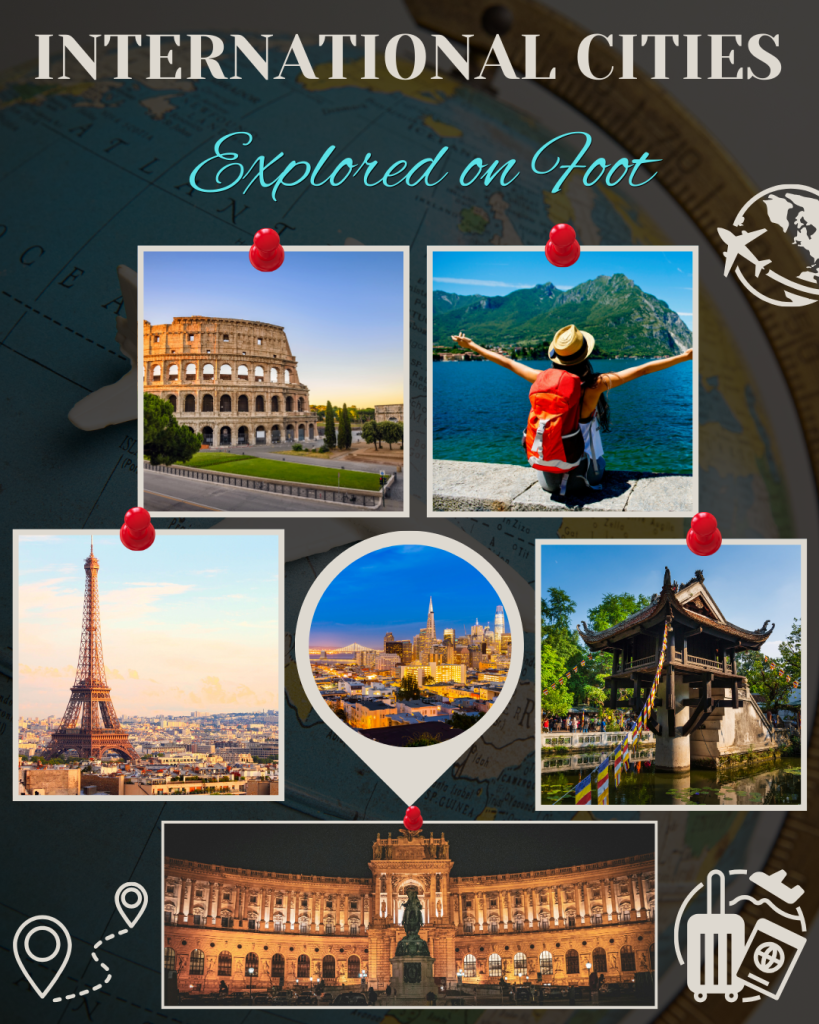

There are certain cities that should never be travelled through on fast-forward. They `are to be sensed stage by stage. You see more of international cities on foot compared to driving a car or crammed into public transport. And the journey includes street life, architecture, scents and daily rhythms.
Walking gives travelers the opportunity to stop, to observe, to connect. Hence the cities which are walkable provide storage of high-end experiences. It is easy to get lost in historic centers, but walking turns sightseeing into storytelling.
International Cities on Foot Feel More Personal and Engaging
Cities that are traversed impart a sense of intimacy for the traveler. It feels secondnature to walk your streets and landmarks are always surprising.
You are exposed to local cafés, markets and hidden alleys easily with international cities on foot. This makes travel more like a spontaneous pursuit, rather than a fixed agenda. Besides, walking helps you meet local people and enjoy the way of life.
International Cities on Foot in Europe’s Historic Centers
The European compact city is a shape that evolved long before typologies of modern transport took hold. The best way to go around them is by foot, usually.
International Cities on Foot – Rome
For those who have not yet discovered it, Rome is an open-air museum. Within walking distance are ancient ruins, churches, and piazzas.
Rome has it all unfolding quite naturally, however, on foot through international cities. As a result, the city doesn’t feel too much but rather alive!
International Cities on Foot – Paris
Paris is designed for walking. Boulevards, riverbanks and neighbourhoods flow together.
When the world walks in cities, Paris lives in cafés, bookshops and quiet streets. Which is why romance and culture come easy.
International Cities on Foot in Central Europe
As cities in Central Europe are small and the towns are very pedestrian-friendly, walking is very pleasant.
International Cities on Foot – Prague
Prague, with its cobbled streets and medieval layout, is one of those cities that begs to be explored on foot.
Historic squares, bridges, and viewpoints are traversed on foot through international cities. And this makes the city feel still and pedestrian friendly.
International Cities on Foot – Vienna
The old town in Vienna is very well to do and peaceful.
Discover imperial architecture, museums, and coffee houses comfortably on foot with international cities. That is why one has the experience of elegance slow.
International Cities on Foot in Asia’s Cultural Hubs
Our own ‘interesting’ Asian cities with walkable districts full of culture and vitality.
International Cities on Foot – Kyoto
Slow exploration is rewarded in the traditional neighborhoods of Kyoto.
Quietly, temples, shrines, and ancient streets are found through international cities on foot. So there is a lot of cultural depth.
International Cities on Foot – Hanoi
The best way to explore Hanoi’s Old Quarter is on foot.
International cities are on foot, which lends itself to street food, markets, and colonial architecture. Thus, the city buzzes with life, guided with motor vehicles, moving from one place to another.
International Cities on Foot in the Americas
American Cities That Are Great for Walking Some American Cities Are Ideally Laid out and Offer Many Attractions Within Walking Distance
International Cities on Foot – New York City
Every neighborhood in New York feels different and has a walkable atmosphere.
Parks, streets, and landmarks all interconnect seamlessly making transporting through & between the international cities a foot walk; Thus, urban exploration is more: it is alive, it is experiential.
International Cities on Foot – San Francisco
Rocky roads—yet the compact districts of San Francisco push walking above all even if there are hills.
You enjoy waterfronts, historic streets and cultural quarters on foot in international cities. Therefore, character is experienced fully.
International Cities on Foot Offer Cultural Discovery
My experience with culture is in the small nuances. Which walking makes some room in order to notice them.
You see local customs, street art, and architecture up close with feet in the same places where your feet walk. This makes cities feel understood instead of just being visited.
International Cities on Foot Promote Healthier Travel
Walking promotes mental and physical health.
International cities by foot keep travelers on the move while taking in the sights. As a result, the energy levels remain stabilized, and fatigue is minimized.
International Cities on Foot Reduce Travel Stress
Transport planning often creates stress.
International cities are on foot, which makes the schedule easier and the action more flexible. As a result, travel is more peaceful and fun.
International Cities on Foot Are Budget-Friendly
Walking saves money on transport.
Walking Tour of Top Attractions: Attractions overall a walkable city which means others in the region are reached for free. Because of this, budgets for travel are spent on experiences and not on logistics.
International Cities on Foot Encourage Sustainable Tourism
Walking supports eco-friendly travel.
In a world where international cities are accessible on foot, carbon footprints are smaller and local communities flourish. Therefore, travel becomes more responsible.
International Cities on Foot Reveal Hidden Gems
You can never find hidden gems on the main road.
Scouring through the backstreets of international metropolises, lead to little art galleries, hole-in-the-wall cafés, and all of those unusual places. Consequently, travel memories become unique.
Why International Cities on Foot Create Better Travel Experiences
Fast travel limits connection.
Walking, naturally, slows down travel in international cities. Experiences feel deeper, quieter, more real.
Conclusion: International Cities on Foot Offer the Most Meaningful Exploration
Streets, individuals, and normal life speak the stories of towns. These stories are easily heard when walking.
Using feet in international buildings we have stronger life experiences, greater memories and real cultural literacy. And indeed a city is best known by walking through it heart.